The Very Little Origin.
Shooting on Very_little_time began the day after Thanksgiving. The true origin of the
movie can be traced back a couple weeks before that particular Thanksgiving, when we
were in the kitchen, discussing what steps should be taken to hone our movie making
skills in preparation for the future. Very_little_time was not intended to actually exist as a
movie. It was supposed to be a way for us to answer the questions we had about movie
making. In short, it was just supposed to be practice, and nobody was supposed to see it,
except us. The reason we were looking for practice, and the reason that we had these
movie making questions on our minds is simple. We are currently working on over 35
movie scripts and we have two scripts actually completed, so in anticipation of making
those movies, we decided that it would be a good idea to get some real world, hands on
practice, using our video camera. We had made some simple tests with our camera,
piecing together some basic, generic, meaningless shots, but we decided that the only
effective way to practice was to tell a legitimate story with a miniature movie. This lead to
the conversation in the kitchen, where we discussed our options. At first, we considered
making a thirty second short, designed to look like a television commercial. Since we had
no money and no equipment for this little training project, we liked the ease and
convenience of the thirty second idea, however, we quickly realized that we would prefer
something with a story, even if that did bring the sizeable burden of a more elaborate
production. We would now have to build all of our equipment from scratch. We would
have to shoot the movie over multiple weeks and in multiple locations. We've had a lot of
experience theorizing movie production. We've spent the last decade doing just that, and
now this was an opportunity to put those theories to the test, on an extremely small scale,
of course, and without the benefit of a budget.
After the completion of our first script, Inventor's Day, we drafted a detailed budget and
production plan, which incorporated 100 employees, over 40 sets, and over 65 actors,
calling for 6.2 million dollars. Creating that budget and production plan gave us a great
insight into the detailed needs of motion picture production. Over the last ten years, we
have developed a unique production style and shooting style, which has only existed in
theory. Now, this mini-movie was going to give us the opportunity to test our theories.
As soon as we made the decision to go ahead with the movie, we started working on the
story. This story, though, had many restrictions on it from the very start. We didn't have
any money to buy anything, so we would have to use what we had. The only location
possibilities for us were our home and the woods surrounding our home, so the movie
would have to take place there, which means that the story would have to be weaved
around these locations. Since we weren't going to be bringing any items into the movie,
we had to look around our home and assess what we already had. We found, of course,
an abundance of common household items, so we decided to incorporate these common
products into the movie in a way that would make them seem more important and more
interesting.
Another stipulation for the movie was that it would only have one actor, so the story had to
revolve around one character.
Shooting on Very_little_time began the day after Thanksgiving. The true origin of the
movie can be traced back a couple weeks before that particular Thanksgiving, when we
were in the kitchen, discussing what steps should be taken to hone our movie making
skills in preparation for the future. Very_little_time was not intended to actually exist as a
movie. It was supposed to be a way for us to answer the questions we had about movie
making. In short, it was just supposed to be practice, and nobody was supposed to see it,
except us. The reason we were looking for practice, and the reason that we had these
movie making questions on our minds is simple. We are currently working on over 35
movie scripts and we have two scripts actually completed, so in anticipation of making
those movies, we decided that it would be a good idea to get some real world, hands on
practice, using our video camera. We had made some simple tests with our camera,
piecing together some basic, generic, meaningless shots, but we decided that the only
effective way to practice was to tell a legitimate story with a miniature movie. This lead to
the conversation in the kitchen, where we discussed our options. At first, we considered
making a thirty second short, designed to look like a television commercial. Since we had
no money and no equipment for this little training project, we liked the ease and
convenience of the thirty second idea, however, we quickly realized that we would prefer
something with a story, even if that did bring the sizeable burden of a more elaborate
production. We would now have to build all of our equipment from scratch. We would
have to shoot the movie over multiple weeks and in multiple locations. We've had a lot of
experience theorizing movie production. We've spent the last decade doing just that, and
now this was an opportunity to put those theories to the test, on an extremely small scale,
of course, and without the benefit of a budget.
After the completion of our first script, Inventor's Day, we drafted a detailed budget and
production plan, which incorporated 100 employees, over 40 sets, and over 65 actors,
calling for 6.2 million dollars. Creating that budget and production plan gave us a great
insight into the detailed needs of motion picture production. Over the last ten years, we
have developed a unique production style and shooting style, which has only existed in
theory. Now, this mini-movie was going to give us the opportunity to test our theories.
As soon as we made the decision to go ahead with the movie, we started working on the
story. This story, though, had many restrictions on it from the very start. We didn't have
any money to buy anything, so we would have to use what we had. The only location
possibilities for us were our home and the woods surrounding our home, so the movie
would have to take place there, which means that the story would have to be weaved
around these locations. Since we weren't going to be bringing any items into the movie,
we had to look around our home and assess what we already had. We found, of course,
an abundance of common household items, so we decided to incorporate these common
products into the movie in a way that would make them seem more important and more
interesting.
Another stipulation for the movie was that it would only have one actor, so the story had to
revolve around one character.
The World's Hottest Dining
Room.
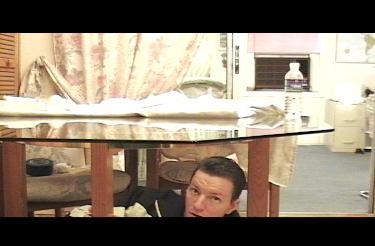
Where's the hottest place on Earth? Under the dining room
table. Take our word for it. While filming inside, the
temperature would soar to something in the 3-digit range, due
to the heavy duty, high output work lights that filled each shot.
Positioned just outside the view of the camera, these
monsters took up most of the available space in the room,
blocking each passage and walkway, seeming to even block
out the movement of air as they forced staggeringly high
volumes of light into each scene. With this very necessary
illumination came very unnecessary and unwanted heat, and
lots of it. The air inside the circle of lights felt like the air
inside a microwave, and we had to get in that microwave for
each shot. The hottest it ever got was probably under the
dining room table. There are no windows in that room and all
the heat seemed to get trapped under the glass top of the
table. Of course, all of this was compounded by the fact that
jeans, a sweater, and a jacket had to be worn in all of the
shots that took place under that table. Fortunately, nobody
spontaneously combusted, and in the movie, none of the
scenes look uncomfortably hot.
Room.
Where's the hottest place on Earth? Under the dining room
table. Take our word for it. While filming inside, the
temperature would soar to something in the 3-digit range, due
to the heavy duty, high output work lights that filled each shot.
Positioned just outside the view of the camera, these
monsters took up most of the available space in the room,
blocking each passage and walkway, seeming to even block
out the movement of air as they forced staggeringly high
volumes of light into each scene. With this very necessary
illumination came very unnecessary and unwanted heat, and
lots of it. The air inside the circle of lights felt like the air
inside a microwave, and we had to get in that microwave for
each shot. The hottest it ever got was probably under the
dining room table. There are no windows in that room and all
the heat seemed to get trapped under the glass top of the
table. Of course, all of this was compounded by the fact that
jeans, a sweater, and a jacket had to be worn in all of the
shots that took place under that table. Fortunately, nobody
spontaneously combusted, and in the movie, none of the
scenes look uncomfortably hot.
Death Pays a Very Little Visit.
In the middle of the woods, surrounded by thick shrubbery and shaded by
an assorted collection of trees, Tim stands in front of the camera, reciting
his lines as Todd watches. Nodding his head approvingly, Todd has seen
enough, and he stops his brother. "That's good. You got it," he says, "Now
step this way. There's a water moccasin behind you." The lack of
excitement in his voice doesn't confuse Tim at all. In fact, it's exactly what
he would expect. Having spent their childhood in a small zoo, which was run
by their family, the brothers have become accustomed to wildlife, even the
dangerous kind. Having heeded his brother's warning, Tim takes a step
forward and turns to look, as the snake continues to crawl toward him.
The rule regarding snakes is simple. Never kill a snake, unless it is
poisonous. There are only four poisonous species of snakes in the
continental United States, so the odds are certainly on this creature's side,
but those four species are the rattlesnake, the copperhead, the coral
snake, and finally, the water moccasin, also known as the cotton mouth, so,
unfortunately, the rule, as lenient as it is, appears to be bad news for this
fellow. Nonetheless, the rule is not without merit. Even the most avid snake
lovers realize the incredible damage that a water moccasin can inflict. Like
the rattlesnake and the copperhead, the moccasin uses a hemotoxin to kill
its prey, as opposed to the neurotoxin found in the coral snake. While
death from a snake bite in the United States is very rare, there is much
more than a possible fatality to consider here. All too often, the worst part
of a potential snake bite is overlooked and unmentioned. The hemotoxin
that a moccasin uses is not a gentle killer like the neurotoxin of the coral
snake. Found also in the cobra, the neurotoxin kills by shutting down the
nervous system, leaving the victim unable to breath and eventually stopping
the heart. The hemotoxin, on the other hand, is quite different. It works like
a powerful acid, destroying tissue on contact. Many survivors of hemotoxin
bites are left with severe skin and muscle damage at the point of attack,
leaving them with blackened and disfigured scar tissue, resembling a third
degree burn. Bites have been documented in which the powerful hemotoxin
has caused the meat of a finger to liquify and drip off the bone shortly after
an attack. This is certainly not the type of animal that can be taken lightly,
and when one encroaches on territory occupied by humans, it poses a
serious threat to the safety of the community. One of these creatures could
easily kill a child or cripple an adult with one quick strike. Leaving such a
sizeable and obvious hazard in place would be nothing short of
recklessness, so this fellow had to be removed from the area.
In the middle of the woods, surrounded by thick shrubbery and shaded by
an assorted collection of trees, Tim stands in front of the camera, reciting
his lines as Todd watches. Nodding his head approvingly, Todd has seen
enough, and he stops his brother. "That's good. You got it," he says, "Now
step this way. There's a water moccasin behind you." The lack of
excitement in his voice doesn't confuse Tim at all. In fact, it's exactly what
he would expect. Having spent their childhood in a small zoo, which was run
by their family, the brothers have become accustomed to wildlife, even the
dangerous kind. Having heeded his brother's warning, Tim takes a step
forward and turns to look, as the snake continues to crawl toward him.
The rule regarding snakes is simple. Never kill a snake, unless it is
poisonous. There are only four poisonous species of snakes in the
continental United States, so the odds are certainly on this creature's side,
but those four species are the rattlesnake, the copperhead, the coral
snake, and finally, the water moccasin, also known as the cotton mouth, so,
unfortunately, the rule, as lenient as it is, appears to be bad news for this
fellow. Nonetheless, the rule is not without merit. Even the most avid snake
lovers realize the incredible damage that a water moccasin can inflict. Like
the rattlesnake and the copperhead, the moccasin uses a hemotoxin to kill
its prey, as opposed to the neurotoxin found in the coral snake. While
death from a snake bite in the United States is very rare, there is much
more than a possible fatality to consider here. All too often, the worst part
of a potential snake bite is overlooked and unmentioned. The hemotoxin
that a moccasin uses is not a gentle killer like the neurotoxin of the coral
snake. Found also in the cobra, the neurotoxin kills by shutting down the
nervous system, leaving the victim unable to breath and eventually stopping
the heart. The hemotoxin, on the other hand, is quite different. It works like
a powerful acid, destroying tissue on contact. Many survivors of hemotoxin
bites are left with severe skin and muscle damage at the point of attack,
leaving them with blackened and disfigured scar tissue, resembling a third
degree burn. Bites have been documented in which the powerful hemotoxin
has caused the meat of a finger to liquify and drip off the bone shortly after
an attack. This is certainly not the type of animal that can be taken lightly,
and when one encroaches on territory occupied by humans, it poses a
serious threat to the safety of the community. One of these creatures could
easily kill a child or cripple an adult with one quick strike. Leaving such a
sizeable and obvious hazard in place would be nothing short of
recklessness, so this fellow had to be removed from the area.
Making the Movie a Brighter Place -
Lighting the Shots.
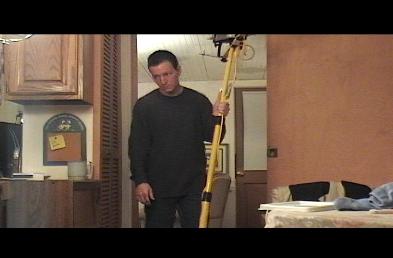
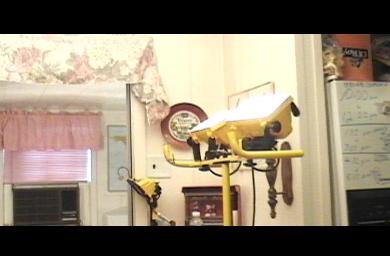
The human eye is remarkable at picking up images in almost any light conditions.
The lens of a camera is not so amazing in this regard, so shop lights had to be
added to every shot to customize the lighting conditions for the needs of the
camera. These lights were then manipulated to create the desired look on the
screen. Each lighting adjustment has an effect on the shot, rendering a
completely different picture of the same scene. Most shots were lit with seven to
ten lights, and these lights were adjusted and readjusted one at a time to sculpt
the look of the movie. This process could take anywhere from fifteen minutes to
close to an hour. That time entails resizing light stands, tilting the angle of the
lamps, turning lamps on or off, placing homemade diffusers over the lights (we
used sewing hoops with white, blue or black cloth stretched over them), placing
homemade light reflectors in the right areas to lessen the effect of shadows (we
used white cloth stretched over homemade PVC squares), not to mention
enduring blackouts from breakers flipping due to excessive power consumption,
and the occasional burn from forgetful or generally careless handling of the
lamps. Also, there's a substantial amount of tripping over cables involved in this
process. Extension cords were running everywhere, in every direction, as lights
of all sizes were hanging from every imaginable crook and crevice and affixed to
any protrusion that we could find. Not only did we have to light the rooms in
which the action was taking place, we also had to light any rooms in the distant
background that would be seen, so that those rooms would show up well on
screen and fit into the look of the movie.
Lighting the Shots.
The human eye is remarkable at picking up images in almost any light conditions.
The lens of a camera is not so amazing in this regard, so shop lights had to be
added to every shot to customize the lighting conditions for the needs of the
camera. These lights were then manipulated to create the desired look on the
screen. Each lighting adjustment has an effect on the shot, rendering a
completely different picture of the same scene. Most shots were lit with seven to
ten lights, and these lights were adjusted and readjusted one at a time to sculpt
the look of the movie. This process could take anywhere from fifteen minutes to
close to an hour. That time entails resizing light stands, tilting the angle of the
lamps, turning lamps on or off, placing homemade diffusers over the lights (we
used sewing hoops with white, blue or black cloth stretched over them), placing
homemade light reflectors in the right areas to lessen the effect of shadows (we
used white cloth stretched over homemade PVC squares), not to mention
enduring blackouts from breakers flipping due to excessive power consumption,
and the occasional burn from forgetful or generally careless handling of the
lamps. Also, there's a substantial amount of tripping over cables involved in this
process. Extension cords were running everywhere, in every direction, as lights
of all sizes were hanging from every imaginable crook and crevice and affixed to
any protrusion that we could find. Not only did we have to light the rooms in
which the action was taking place, we also had to light any rooms in the distant
background that would be seen, so that those rooms would show up well on
screen and fit into the look of the movie.
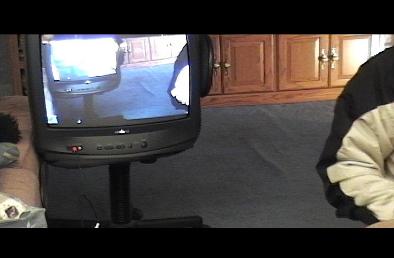
To aide us in this process, by giving us a clear, instant view of the lighting effect, we
placed our television on a rolling chair, plugged the camera into it, and found a spot for
its cord in the congested collection of extension cord outlets. This allowed us to roll the
television wherever it was needed to accommodate the rest of the equipment and stay
out of the way of the camera. This also meant that we had to unhook our television
every single day, muscle it down from the shelf, and set it in the chair, then at the end of
the day, we had to fight it back into its position and hook up the cables so that we could
watch half of whatever program happened to be on right before we went to bed.
placed our television on a rolling chair, plugged the camera into it, and found a spot for
its cord in the congested collection of extension cord outlets. This allowed us to roll the
television wherever it was needed to accommodate the rest of the equipment and stay
out of the way of the camera. This also meant that we had to unhook our television
every single day, muscle it down from the shelf, and set it in the chair, then at the end of
the day, we had to fight it back into its position and hook up the cables so that we could
watch half of whatever program happened to be on right before we went to bed.
The Sound.
All of the sound for the movie was recorded separately. When the movie footage was
edited together, it was completely without the sound track. The soundtrack had to be
made entirely from scratch to perfectly match the video. The reason for recording the
soundtrack separately is for the sake of quality. Doing it this way, we were able to get
perfectly crisp, clear, controlled sound that would have been impossible to capture
during the shooting process. However, this process required us to go through the
entire 1hr 20min movie, second by second, frame by frame, adding the proper sound
at the proper moment, and in many cases this required us to specially mix the sounds
to generate the desired effect, often cutting the sounds into pieces and even blending
two different sounds together to create the right feel.
All of the sound for the movie was recorded separately. When the movie footage was
edited together, it was completely without the sound track. The soundtrack had to be
made entirely from scratch to perfectly match the video. The reason for recording the
soundtrack separately is for the sake of quality. Doing it this way, we were able to get
perfectly crisp, clear, controlled sound that would have been impossible to capture
during the shooting process. However, this process required us to go through the
entire 1hr 20min movie, second by second, frame by frame, adding the proper sound
at the proper moment, and in many cases this required us to specially mix the sounds
to generate the desired effect, often cutting the sounds into pieces and even blending
two different sounds together to create the right feel.
The Music.
For the music in Very_little_time, classical compositions were dissected and edited together to
achieve the desired effect. Many different compositions were blended to achieve the right musical
feel for each moment in each scene. Also, a lot of looping was used, playing the same short
segment of a composition over and over again, sometimes just a few seconds of music, to keep the
same feel circulating through the scene.
For the music in Very_little_time, classical compositions were dissected and edited together to
achieve the desired effect. Many different compositions were blended to achieve the right musical
feel for each moment in each scene. Also, a lot of looping was used, playing the same short
segment of a composition over and over again, sometimes just a few seconds of music, to keep the
same feel circulating through the scene.
The Voice.
Just like the sound, the voice was recorded entirely after the movie was shot. We
watched the movie playing on our television and recorded the voice to match it. Only
about ten seconds of voice could be recorded at one time, in order to make sure that it
stayed in sync with the movie. All of these little pieces of voice were then arranged and
matched to the movie.
Just like the sound, the voice was recorded entirely after the movie was shot. We
watched the movie playing on our television and recorded the voice to match it. Only
about ten seconds of voice could be recorded at one time, in order to make sure that it
stayed in sync with the movie. All of these little pieces of voice were then arranged and
matched to the movie.
Creating the Equipment
Once we decided to make the movie, we had to take an assessment of what
equipment we had. It wasn't much. We had a digital home video camera, which, at
the time of its purchase, many months earlier, had been selected because of its price.
It was very, very, cheap, certainly nowhere near the top of the line, more like the
bottom. You see, at that time, we had no idea that we would be making a movie with
it. That wouldn't have made any difference anyway, since we didn't exactly have the
type of bank account that would allow us to be choosy. Anyway, we find ourselves
about to start production on a movie, armed only with a video camera and something
to set it on, actually something very old but very good to set it on. Back in 1986,
before the Internet, before we could drive, before television got really good, eighty
dollars bought us a Bogen tripod, which not only supported a camera that we received
as a Christmas present, but also supported an enthusiastic love of photography. We
were and still are of the opinion that a picture should make something happen.
Ideally, a photograph should make the viewer wonder what happened right before the
shot was captured and make them wonder what happened right after that instant in
time, but at the very least, a picture should make a person feel a certain way about
what they're seeing, instead of simply documenting a space in time. Anyway, let's get
back to the point at hand, which, in this particular moment in time, is that tripod. It's
probably the most reliable piece of equipment we've ever encountered. Even after 18
years, it's still in perfect condition, functioning exactly as it did when it was brand new.
That Christmas present camera didn't quite make it that long, but it had an impressive
run, itself. It lasted somewhere in the neighborhood of ten years before Shamu the
killer whale decided to kill it with about 40,000 gallons of freezing cold salt water
propelled over the wall of his tank. This is a daily ritual performed at each show, very
much on purpose, and designed to thrill the audience and destroy all electronic
devices in a quarter mile radius; that day, it was successful on both fronts. Also, it
seems to delight the heck out of the band of young children that shows up at every
show, gathering together at the front of the tank as Shamu makes his final pass,
giggling in anticipation of the expected event. That's the children giggling, not
Shamu. Well, on second thought, Shamu might be giggling, but it's really rather
difficult to read the emotions of a killer whale. They tend to stay expressionless no
matter what happens. Anyway, he made the splash, thrilled the kids, and completely
saturated us. That's how our camera got destroyed. Well, that's the extended
version. The short version is that it got wet, and the salt ate through the internal
wiring. Either way you tell it, after that, it started snapping photos on its own. It
wouldn't mind at all, and we had to retire it.
So, that leaves us with a digital camera and a tripod. Everything else, we had to
make.
Once we decided to make the movie, we had to take an assessment of what
equipment we had. It wasn't much. We had a digital home video camera, which, at
the time of its purchase, many months earlier, had been selected because of its price.
It was very, very, cheap, certainly nowhere near the top of the line, more like the
bottom. You see, at that time, we had no idea that we would be making a movie with
it. That wouldn't have made any difference anyway, since we didn't exactly have the
type of bank account that would allow us to be choosy. Anyway, we find ourselves
about to start production on a movie, armed only with a video camera and something
to set it on, actually something very old but very good to set it on. Back in 1986,
before the Internet, before we could drive, before television got really good, eighty
dollars bought us a Bogen tripod, which not only supported a camera that we received
as a Christmas present, but also supported an enthusiastic love of photography. We
were and still are of the opinion that a picture should make something happen.
Ideally, a photograph should make the viewer wonder what happened right before the
shot was captured and make them wonder what happened right after that instant in
time, but at the very least, a picture should make a person feel a certain way about
what they're seeing, instead of simply documenting a space in time. Anyway, let's get
back to the point at hand, which, in this particular moment in time, is that tripod. It's
probably the most reliable piece of equipment we've ever encountered. Even after 18
years, it's still in perfect condition, functioning exactly as it did when it was brand new.
That Christmas present camera didn't quite make it that long, but it had an impressive
run, itself. It lasted somewhere in the neighborhood of ten years before Shamu the
killer whale decided to kill it with about 40,000 gallons of freezing cold salt water
propelled over the wall of his tank. This is a daily ritual performed at each show, very
much on purpose, and designed to thrill the audience and destroy all electronic
devices in a quarter mile radius; that day, it was successful on both fronts. Also, it
seems to delight the heck out of the band of young children that shows up at every
show, gathering together at the front of the tank as Shamu makes his final pass,
giggling in anticipation of the expected event. That's the children giggling, not
Shamu. Well, on second thought, Shamu might be giggling, but it's really rather
difficult to read the emotions of a killer whale. They tend to stay expressionless no
matter what happens. Anyway, he made the splash, thrilled the kids, and completely
saturated us. That's how our camera got destroyed. Well, that's the extended
version. The short version is that it got wet, and the salt ate through the internal
wiring. Either way you tell it, after that, it started snapping photos on its own. It
wouldn't mind at all, and we had to retire it.
So, that leaves us with a digital camera and a tripod. Everything else, we had to
make.
Early Morning Dews and Don'ts.
We quickly discovered that filming outside had a unique and unexpected
limitation that was not present when filming inside. We were looking forward to
filming outside and being free of the restraints that come with the cramped
workspace of filming inside, not to mention the intricate maze of extension cords and
lights that are necessary for shooting in a house. Definitely outside would give us
more space. We knew to anticipate a number of limitations when making the
transition from inside to outside. For example, changing weather conditions never
presented a problem when we filmed inside, but outside, we would have to work
around the rain, and even heavy wind could present a problem. There was one
particular little unforseen complication with filming in the great outdoors. We had
become acustomed to being able to film as early or late as we wanted, and we
naively expected the same luxury from the outdoor shoot, provided that the sun was
out, of course. However, on our first early morning, we found ourselves racing to
get the equipment in place to take advantage of the first light, and we noticed that
the ground was covered with a thick dew, threatening to instantly soak our clothing
and equipment. This new development in our schedule afforded us a little extra
sleep in the morning. As it turns out, we had to wait for the ground to dry completely
before we could start shooting, which happened everyday at about 10:00 am.
We quickly discovered that filming outside had a unique and unexpected
limitation that was not present when filming inside. We were looking forward to
filming outside and being free of the restraints that come with the cramped
workspace of filming inside, not to mention the intricate maze of extension cords and
lights that are necessary for shooting in a house. Definitely outside would give us
more space. We knew to anticipate a number of limitations when making the
transition from inside to outside. For example, changing weather conditions never
presented a problem when we filmed inside, but outside, we would have to work
around the rain, and even heavy wind could present a problem. There was one
particular little unforseen complication with filming in the great outdoors. We had
become acustomed to being able to film as early or late as we wanted, and we
naively expected the same luxury from the outdoor shoot, provided that the sun was
out, of course. However, on our first early morning, we found ourselves racing to
get the equipment in place to take advantage of the first light, and we noticed that
the ground was covered with a thick dew, threatening to instantly soak our clothing
and equipment. This new development in our schedule afforded us a little extra
sleep in the morning. As it turns out, we had to wait for the ground to dry completely
before we could start shooting, which happened everyday at about 10:00 am.
How to turn your bedroom into a
recording studio.
If the need should arise, you may want to turn your bedroom into a recording
studio. Here are a few tips to streamline that process. First, you have to
remember that your new studio will need to be as sound proof as possible. To
help accomplish this, locate a comforter or cover or throw rug or priceless antique
quilt, anything that you can find to toss over the door of your room. This item
should be draped over the top of your door, covering the top and the side without
the hinges. Fold the ends several times, if you have to, as it should be large
enough to create enough obstruction so that shutting the door is a definite
impossibility. The next step is to push on the door so hard that is shuts. This will
make a pretty good seal. You're not finished, yet. Next, you need to toss a pair
of pants on the floor at the base of the door and poke them into the crevasse with
your foot. This should be an old pair of pants from the hamper, not a new, clean
pair. If you're turning your room into a sound recording studio instead of renting
a real studio, you don't have enough money to throw new pairs of pants around.
recording studio.
If the need should arise, you may want to turn your bedroom into a recording
studio. Here are a few tips to streamline that process. First, you have to
remember that your new studio will need to be as sound proof as possible. To
help accomplish this, locate a comforter or cover or throw rug or priceless antique
quilt, anything that you can find to toss over the door of your room. This item
should be draped over the top of your door, covering the top and the side without
the hinges. Fold the ends several times, if you have to, as it should be large
enough to create enough obstruction so that shutting the door is a definite
impossibility. The next step is to push on the door so hard that is shuts. This will
make a pretty good seal. You're not finished, yet. Next, you need to toss a pair
of pants on the floor at the base of the door and poke them into the crevasse with
your foot. This should be an old pair of pants from the hamper, not a new, clean
pair. If you're turning your room into a sound recording studio instead of renting
a real studio, you don't have enough money to throw new pairs of pants around.

| very_little_time |
| read more |